
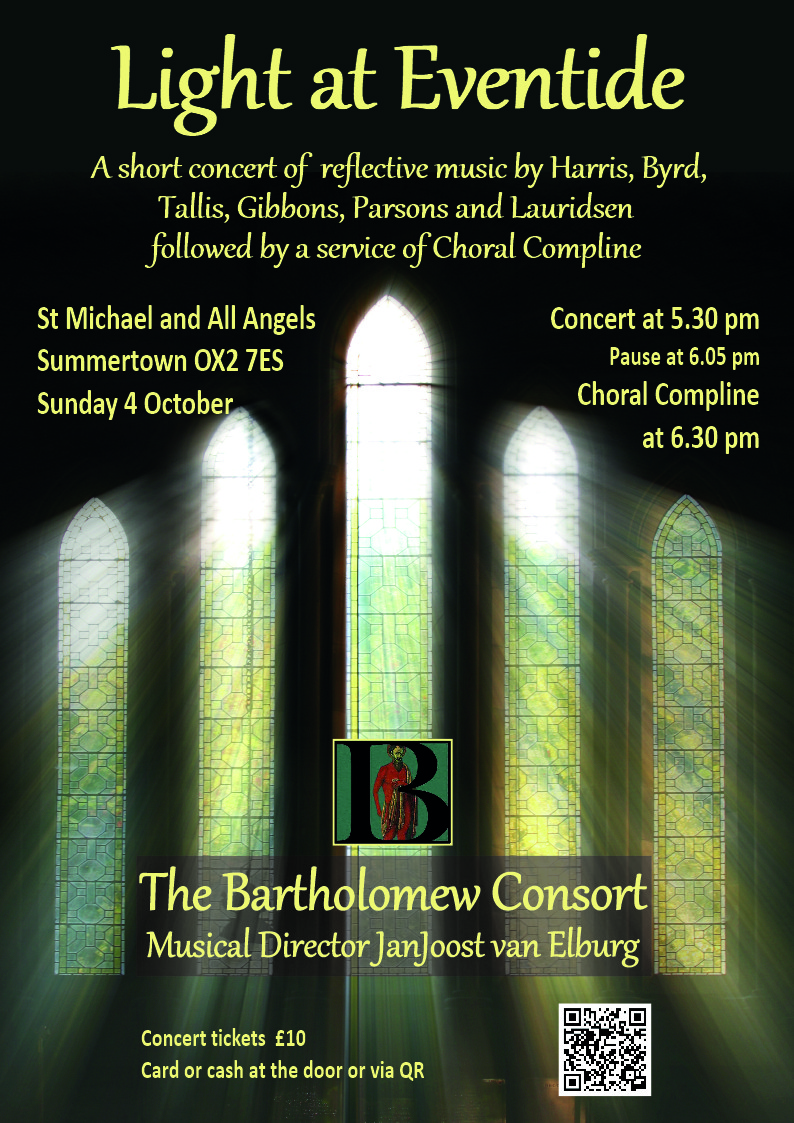
Join the Bartholomew Consort under the direction of
JanJoost van Elburg to enjoy a performance of Palestrina’s
wonderful mass for double choir,
Confitebor tibi Domine
In this year when we celebrate the 500th anniversary of
Palestrina’s birth there have been many tributes offered
for his output of great music, yet few have included
this particular Mass. The movements will be interspersed
with other multivoice works by English near contemporaries
William Byrd and Thomas Tomkins as well as an uplifting
anthem by the Edwardian composer, Charles Stanford.
Tickets are available now
https://www.ticketsource.co.uk/bartholomew-consort/t-qmvxdqj
https://maps.app.goo.gl/mBWnmse9Kr3tLMAN6
Texts and a few notes about the Programme
William Byrd 1540-1623 Praise our Lord, all ye gentiles
Praise our Lord all ye Gentiles, praise him all ye people
Because his mercy is confirmed upon us, and his truth remaineth for ever. Amen Ps 117
‘Praise Our Lord, all Ye Gentiles’ appears in the 1611 songbook entitled ‘Psalms, songs and sonnets , some solemn, others joyful, framed to the life of the words’ Note that Byrd has rendered the Latin Dominus or Greek Kyrios as ‘our Lord’, rather than ‘ the Lord’ , a form widely understood to indicate a Catholic usage. Byrd was a devout Catholic all his life in spite of the prevailing Protestant landscape of Tudor England in his time. He was obliged to pursue a double life, steering a risky course between his duties to the head of the Church of England, Queen Elizabeth 1, and his unerring loyalty to the Catholic church.
Giovanni Pierluigi da Palestrina 1525-1594 was an Italian composer of late Renaissance music. The central representative of the Roman School, with Orlande de Lassus and Tomás Luis de Victoria, Palestrina is considered the leading composer of late 16th-century Europe. Palestrina was one of the few Renaissance composers never entirely forgotten, but it was the so-called “Palestrinian style” of counterpoint rather than his individual compositions that exerted the greatest influence.
Born in the town of Palestrina in the Papal States, Palestrina moved to Rome as a child and underwent musical studies there. In 1551, Pope Julius III appointed him maestro di cappella of the Cappella Giulia at St. Peter’s Basilica. He left the post four years later, unable to continue as a layman under the papacy of Paul IV, and held similar positions at St. John Lateran and Santa Maria Maggiore in the following decade. Palestrina returned to the Cappella Giulia in 1571 and remained at St Peter’s until his death in 1594.
Primarily known for his masses and motets, which number over 105 and 250 respectively, Palestrina had a long-lasting influence on the development of church and secular music in Europe, especially on the development of counterpoint which earned him an enduring reputation as the ideal Catholic composer, as well as describing his style the stature as a model of perfect achievement.
Missa Confitebor tibi Domine is based on his motet of the same name, in translation meaning I will praise you, O Lord
Kyrie
Lord, have mercy, Christ, have mercy, Lord, have mercy
Gloria
Glory be to God on high,
and on earth peace, good will towards men.
We praise thee, we bless thee,
we worship thee, we glorify thee,
we give thanks to thee for thy great glory,
O Lord God, heavenly King, God the Father Almighty.
O Lord, the only-begotten Son, Jesus Christ;
O Lord God, Lamb of God, Son of the Father,
that takest away the sins of the world, have mercy upon us.
Thou that takest away the sins of the world, receive our prayer.
Thou that sittest at the right hand of God the Father, have mercy upon us.
For thou only art holy; thou only art the Lord;
thou only, O Christ, with the Holy Ghost,
art most high in the glory of God the Father.
Amen
Thomas Tomkins 1572- 1656
O sing unto the Lord a new song: let the congregation of saints sing praise unto him.
Let Israel rejoice in him: and let the children of Sion forever sing Alleluia
Palestrina – Missa Confitebor tibi Domine
Credo
I believe in one God, the Father almighty,
Maker of heaven and earth,
and of all things visible and invisible.
And in one Lord, Jesus Christ,
Only begotten Son of God,
Begotten of his Father before all worlds.
God of God, light of light,
Very God of very God.
Begotten, not made,
being of one substance with the Father:
by whom all things were made.
Who for us men and for our salvation
came down from heaven.
And was incarnate by the Holy Ghost
of the Virgin Mary: And was made man.
And was crucified also for us under Pontius Pilate:
suffered, and was buried.
And the third day He rose again
according to the scriptures.
And ascended into heaven,
and sitteth at the right hand of the Father
And He shall come again
with glory to judge the living and the dead:
His kingdom shall have no end.
And (I believe in) the Holy Ghost, Lord
and giver of life:
Who proceedeth from the Father and Son.
Who with the Father and Son
together is worshipped and glorified:
Who spake by the Prophets.
And in one holy catholic and apostolic church.
I acknowledge one baptism for the remission of sins.
And I look for the resurrection of the dead
And the life of the world to come.
Amen.
Brief Interval
Tomkins
Be strong and of a good courage
and observe the commandements of our God
to walk in his ways and keep his ceremonies,
testimonies and judgments,
and Almighty God prosper thee
withersoever thou goest.
The Lord is thy ruler,
therefore thou shalt want nothing. Be strong and of good courage
Palestrina Missa Confitebor tibi Domine
Sanctus, Benedictus and Agnus
Holy, holy, holy
Lord God of Hosts.
Heaven and earth are full of thy glory.
Hosanna in the highest.
Blessed is he that cometh
in the name of the Lord.
Hosanna in the highest.
Lamb of God, who takes away the sins of the world, have mercy on us.
Lamb of God, who takes away the sins of the world, grant us peace.
Charles Villiers Stanford 1852-1924
Eternal Father, who didst all create,
In whom we live, and to whose bosom move,
To all men be thy name known, which is Love,
Till its loud praises sound at heaven’s high gate.
Perfect thy kingdom in our passing state,
That here on earth thou may’st as well approve
Our service as thou ownest theirs above,
Whose joy we echo and in pain await.
Grant body and soul each day their daily bread:
And should in spite of grace fresh woe begin,
Even as our anger soon is past and dead
Be thy remembrance mortal of our sin:
By thee in paths of peace thy sheep be led,
And in the vale of terror comforted.