
All posts by Catherine Bass
Protected: Friday 15th – Sunday 17th October 2021, OXFORD
Protected: Friday 2nd – Sunday 4th JULY, OXFORD
Protected: Thursday 14th – Sunday 17th OCTOBER 2021, DOESBURG
Protected: Friday 19th – Sunday 21st February 2021, OXFORD
BARTHOLOMEW CONSORT IN sUMMERTOWN, oXFORD 16 fEBRUARY 2020
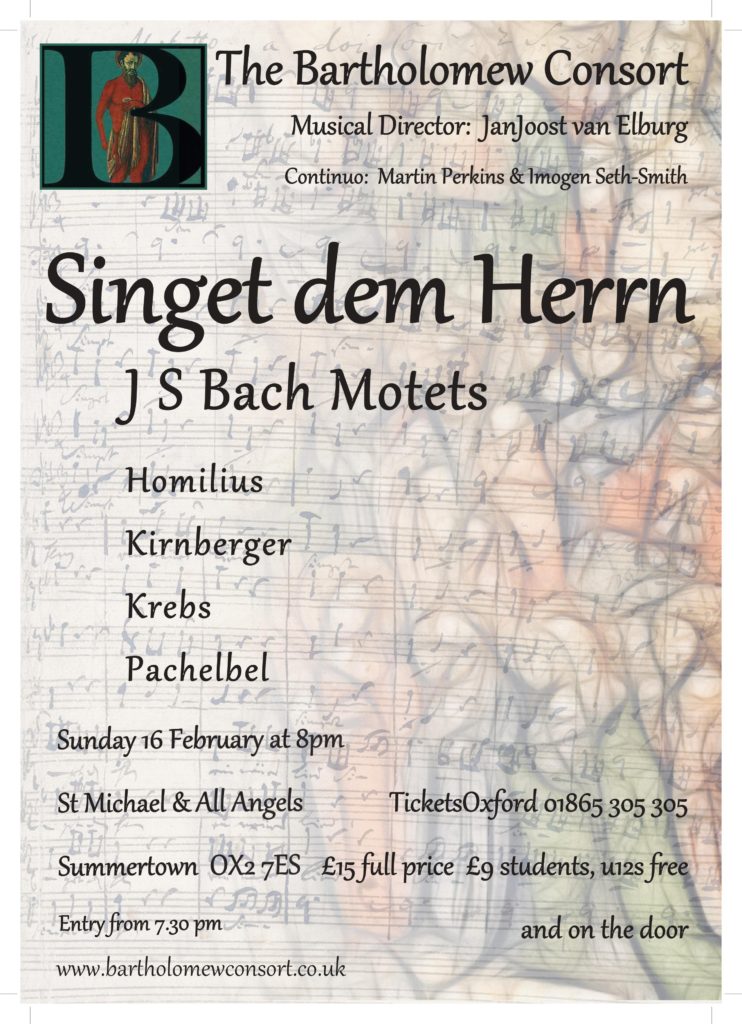
Church of St Michael & All Angels, Summertown OX2 7ES at 8.00 pm. Please note NO entry to the church before 7.30 pm
PROGRAMME
J Pachelbel: Singet dem Herrn
Gott ist unser Zuversicht
J S Bach: Komm, Jesu, komm BWV 229
J L Krebs: Erforsche mich Gott
J P Kirnberger: Wende dich zu mir
G A Homilius: So gehst du nun
J S Bach: Fürchte dich nicht BWV228
Singet dem Herrn BWV225
Tickets at TicketsOxford from early September, full price £15, students, unwaged, jobseekers, disabled £9. Children under 12 free
Protected: Friday 2nd – Sunday 4th October 2020, OXFORD
Protected: Thursday 9th – Sunday 12th July, Doesburg
Protected: FRIDAY 14th – SUNDAY 16th February 2020, OXFORD
Bartholomew Consort in Oxford November 3 at 4 PM

St Barnabas Church, Jericho OX2 6BG Sunday November 3 at 4 pm
Tickets at TicketsOxford from early September, full price £15, students, unwaged, jobseekers, disabled £9. Children under 12 free
Programme
Frank Martin (1890 -1974) Mass for Double Choir
Ildebrando Pizzetti (1880-1968) Missa di Requiem
James MacMillan (b.1959) Lux Aeterna
Musical Director JanJoost van Elburg
In this programme for unaccompanied voices , the two larger works, share some points of details: both were composed in 1922 and both were the only unaccompanied choral works of their composers on liturgical texts.
For Martin, his Mass for Double Choir was a deeply felt and personal work, which he did not release for performance for forty years. His background was in the Calvinist church, his father being a minister, and this coloured his entire life and the characteristic of his creative work. The Mass was written and put away, protected for decades by Martin’s fervently held belief was that it was almost a blasphemy to perform such an intimate and private dialogue between God and himself. His work is entirely his own, embracing the innovative ideas of the early twentieth century.
Pizzetti’s Requiem, on the other hand, is soundly based on the ideas of Gregorian chant and the fifteenth and sixteenth century Italian masters of polyphony. He introduces some vernacular flourishes by frequently changing the number of voice parts within a section, echoing the improvised folk-singing of his native north Italy. It is not certain that Pizzetti held as strong a faith as that of Martin, but the spiritual intensity is just as strong.
The third, shorter, work in this programme is a communion motet by the prolific and hugely admired James MacMillan, published just ten years ago, Lux Aeterna.